


intersense
intersense

Military Case Studies

InterSense provides precision, inertial-based motion tracking systems for military simulation & training solutions.  Our hybrid motion tracking solutions are immune to electro-magnetic interference and offer precise, reliable performance with configuration flexibility to meet the most demanding requirements.
Here are a few examples of how InterSense's motion tracking technology is deployed in the world’s most advanced simulation & training systems.

Aviation Combined Arms Tactical Trainer (AVCATT)

Link_AHMD
Image courtesy of Link Simulation & Training
The key to achieving combat success within today's modern helicopter fleets lies in the ability to conduct mission rehearsals for the entire team. Anywhere, anytime. To support this objective, Link developed key components to the U.S. Army's Combined Arms Tactical Trainer - Aviation Reconfigurable Manned Simulator (AVCATT) program.

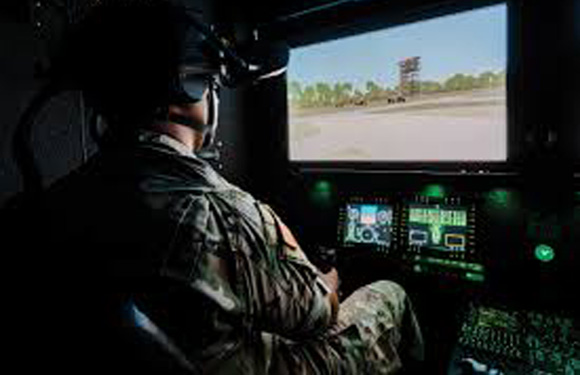
AVCATT is the Army's newest aviation training simulator.  It is a dynamic reconfigurable system used for combined arms collective training and mission rehearsal through networked simulators in a simulated battlefield environment. AVCATT provides training for both active U.S. Army and National Guard units.

AVCATT provides five functional cockpits. These are the OH-58D Kiowa Warrior, the AH-64A Apache, the AH-64D Longbow Apache, the CH-47D Chinook, and the UH-60A/L Blackhawk helicopters. To meet the visual needs of all these cockpits, AVCATT is employing state-of-the-art technology.  This includes the Image Generator, the Helmet Mounted Display, the Multifunction Displays, the Secondary Displays, InterSense IS-900 Head Trackers, and the Close Combat Tactical Trainer (CCTT) terrain databases. 

F/A-18C Distributed Mission Training System (F/A-18C DMT)

F/A-18C Distributed Mission Training System (F/A-18C DMT)
Image courtesy of Link Simulation & Training
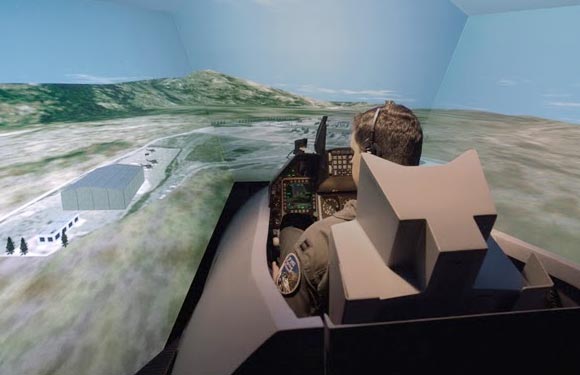
Based on the success of the IS-900 technology deployed with the reconfigurable, rotary wing simulators used in the U.S. Army AVCATT program, Link again is working with InterSense to provide the most reliable head tracking system for this U.S. Navy distributed mission simulation and training program.  Each F/A-18C DMT suite consists of four high fidelity, networked trainers enabling pilots to train simultaneously as a division within a highly realistic, simulated environment.

During night vision training, the pilot uses helmet mounted, night vision goggles to view simulated computer generated imagery. The IS-900 Helmet Tracker tracks pilot head motion to ensure that the correct simulated image seen in the night vision goggles is displayed on the SimuSphere when the pilot moves his head. The helmet tracker’s ergonomic design allows simple and secure placement on individual helmets so pilots can use their personal head gear in the simulator.

Each IS-900 Helmet Tracker takes advantage of InterSense’s latest MiniTrax inertial/acoustic sensing technology. The core inertial sensing components are drift corrected with four ultrasonic receiver microphones positioned to “look down” at an array of ultrasonic transmitters custom fitted into the F/A-18C flight simulator cockpit. 

The flexibility of the IS-900 configuration in Link’s SimuSphere flight cockpit environment eliminates the need for an overhead acoustic referencing structure, thus allowing unobscured 360° pilot vision required by the program.

ExpeditionDI™ – A COTS Man-Wearable Embedded Training Platform for Dismounted Infantry (DI)

ExpeditionDI™ – A COTS Man-Wearable Embedded Training Platform for Dismounted Infantry (DI)
Image courtesy of Quantum3D
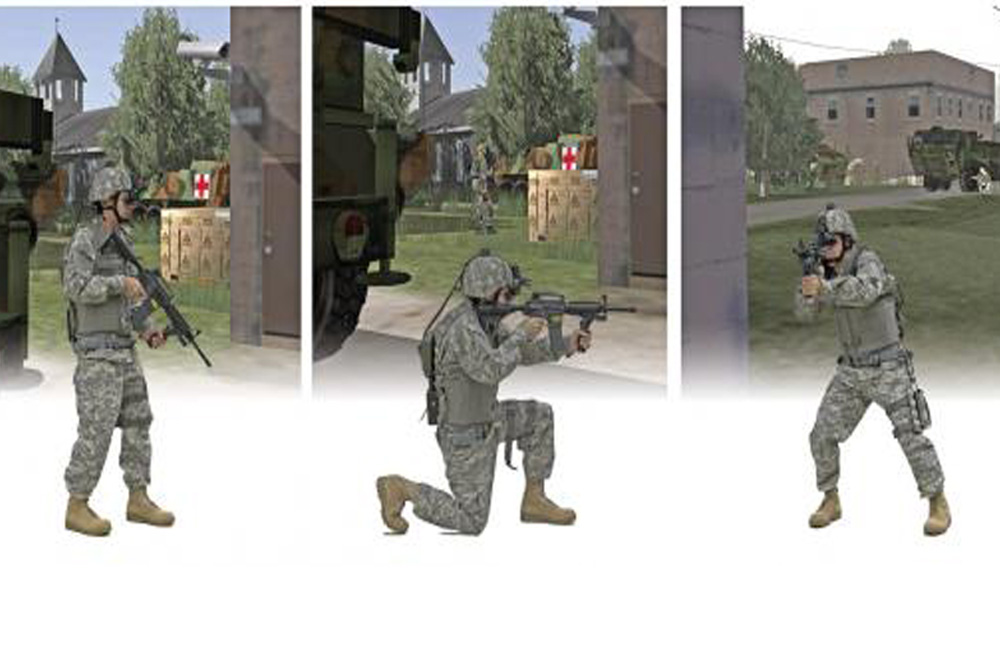
Based on technology developed by CG2® and Quantum3D® for U.S. Army Research Development and Engineering Command (RDECOM), the ExpeditionDI dismounted soldier system provides the U.S. Army and system integrators with a fully functional, high-performance, man-wearable, embedded training/mission rehearsal system for dismounted and mounted infantry. Completely self-contained and featuring wireless communication protocols, ExpeditionDI includes an appropriate Instructor Operator Station (IOS) compatible with OneSAF and legacy Army databases. ExpeditionDI features squad level interaction based on a distributed network of individual soldiers all equipped with the ExpeditionDI training system. With the ability to work within a correlated virtual world, squads can plan missions via the stealth interface, rehearse their course of action prior to the actual training exercise, conduct virtual training exercises while engaging intelligent computer generated forces and perform an After Action Review (AAR) complete with unit scoring and performance assessments.

InterSense worked closely with Quantum3D to assure that InertiaCube sensor technology was correctly integrated to meet the requirements the ExpeditionDI dismounted infantry training system.  InterSense provided integration services to help embed wireless inertial sensor and trigger signals into the training weapon making the weapon a completely tetherless device.

Stinger Troop Proficiency Trainer (STPT)

Stinger Troop Proficiency Trainer (STPT)
Image courtesy of  DME Corporation
DME Corporation designs, manufactures and upgrades proficiency training devices used to train military personnel in the proper procedures and techniques of aerial and ground target engagement. The STPT is an engagement skills trainer for the shoulder-fired infrared radiation, heat-seeking, guided missile systems known as MANPADS.   Utilizing the latest commercially available hardware and software, the STPT provides a state of the art, reliable, effective, low cost training solution for Stinger firing procedures under battle conditions.  Providing interactive three-dimensional simulations of tactical engagement sequences, the device delivers the gunners with the basic technical skills required to successfully engage targets with the Stinger weapon system.

InterSense worked with DME Corp. to integrate the InertiaCube2 and InertiaCube Processors into the Stinger Troop Proficiency Trainer (STPT) as a cost saving upgrade to the training system supporting STPT's mission for providing a low cost, effective training solution.  Systems are deployed with the Hellenic Army, the U.S. Army’s Fort Bliss Air Defense Artillery School, and the U.S. Marine Corps.

Improved Moving Target Simulator (IMTS) (Stinger Missile Trainer)

Improved Moving Target Simulator (IMTS) (Stinger Missile Trainer)
Image courtesy of  AEgis Technologies Group
The Stinger Missile Trainer is a 40 foot dome with projected terrain and aircraft images. The dome allows the trainees a full 360-degree surround scene and 70 degree vertical field of view. The system trains up to three gunners individually or simultaneously, to identify, acquire, and track airborne targets, and then launch a Stinger missile.

The IMTS upgrade program for domed simulators was implemented to improve the overall training efficiency and realism.  As part of the upgrade, InterSense worked with EER Systems (now L-3 Com GIS) and AEgis Technologies to free the trainees from tethers and cables that where connected to training weapons.  

The designed interface sends all of the acquisition, lock, and fire data along with tracking to the IS-900 processor via the InterSense wireless link.  A custom, high accuracy, inertial-acoustic tracking station was designed using MiniTrax technology to improve on the overall accuracy of the training scenario. The tracking station is mounted inside of the Stinger Missile tube with two holes drilled for the ultrasonic receiver microphones.  The IS-900 SoniStrips are mounted under the center projection tower to provide a 20 foot diameter tracking area.

Forward Air Controller Training Simulator (FACSIM)

Forward Air Controller Training Simulator (FACSIM)
Image courtesy of TNO Physics & Electronics Laboratory
Maintaining a force of combat ready Forward Air Controllers is not easily done. Armed Forces are faced with both a growing demand for highly qualified controllers, and a lack of training facilities that are required to fulfill this demand. FACSIM now provides a solution to this problem by effectively supporting the building and maintaining of Forward Air Controller skills.

TNO originally chose the InterSense IS-600 6-DOF tracking system combined with an nVision HMD to provide the trainee with full, stereo immersive visualization of the air control space in the simulation.  

As the system gets deployed, TNO is upgrading to a MiniTrax enabled NVIS HMD with an IS-900 SimTracker.  TNO also plans to use an IS-900 Wireless Wand for pointing and controlling within the visualization space.

Combat Zone Simulator

Combat Zone Simulator
Image courtesy of FAKESPACE
Fakespace Systems Inc. constructed a reconfigurable visualization system as part of an Immersive Environment Simulator used to study how soldiers use equipment in combat zones, at the Army Research Laboratory (ARL). The RAVE IITM visualization system consists of three detachable, large-scale stereoscopic display units that ARL uses to project realistic imagery of simulated hostile environments.

The Immersive Environment Simulator integrates the RAVE II with IS-900 motion tracking and an omni-directional display system consisting of three self-contained rear-projected modules that can be arranged to form a flat wall display, an immersive theater, or an enclosed CAVE®-like environment.  The Immersive Environment Simulator also integrates motion tracking with an omni-directional treadmill allowing soldiers to run and move in any direction within the virtual hostile terrain in order to simulate live combat conditions.

HMS Collingwood Close-Range Weapons Simulation (CRWS) Facility

HMS Collingwood Close-Range Weapons Simulation (CRWS) Facility

HMS Collingwood Close-Range Weapons Simulation (CRWS) Facility
Images courtesy of VP Defence Limited
Operational since 2001 at the Royal Navy’s School of Communications and Weapon Engineering (HMS Collingwood), CRWS is a real-time naval weapons simulator that recreates a wide variety of surface and air engagement scenarios in pre-programmable sea state and weather conditions.

Using state-of-the-art VR techniques, including the latest in head-mounted display technology, weapons students are now able to undertake realistic firing exercises, engaging targets as if located on an actual Royal Navy vessel.  The simulators were commissioned by NRTA and developed by VP Defence Ltd over a period of just 7 months.  By means of a specially designed computer interface, weapons instructors can design and save a variety of training scenarios by using simple mouse and keyboard inputs. Hostile platforms (aircraft, surface vessels and missiles) can be programmed to approach the student’s “own ship” from different bearings and ranges, and at different heights and speeds.

In addition to the weapon aimer’s position, 2 trainees (WDVs) stand on a purpose-built Gunner Director’s Platform (GDP) within the HMS Collingwood simulator facility.  The WDVs are also equipped with HMDs, each having been modified by the addition of a small switch.  Pressing the switch magnifies the view available to the WDV, thereby simulating the use of binoculars.  Calling out and acting on instructions, the WDV and weapons aimers interact to engage incoming targets.  The position and orientation of the weapons and HMDs are tracked in real time using InterSense’s IS-900 tracking systems.